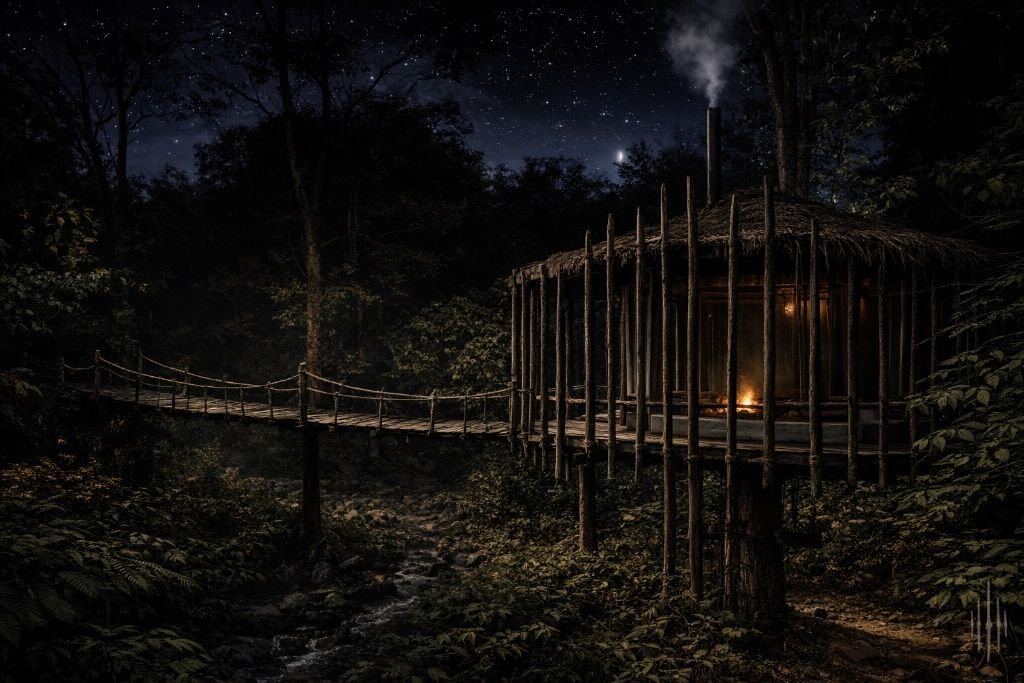
Suspended above the forest floor of Palenque, Mexico a single dwelling that listens to the canopy, breathes with the trees, and dissolves the wall between shelter and wilderness.
Project Overview
Deep within the ancient jungle of Palenque, Mexico where Maya ruins dissolve into dense canopy and the air is thick with rain and growth Cuatro Rumbos was conceived as an act of radical belonging. Not a house placed in a forest, but a shelter grown from it.
The structure rises on a cluster of raw timber columns, lifting the inhabited volume above the forest floor and into the mid-canopy zone where light filters green through leaf, where the calls of birds replace the noise of the world below, and where rain on a thatch roof becomes the most intimate music of shelter.
A slender suspension bridge connects the dwelling to the bank of a forest stream the only threshold between the outside world and this private territory. At night, the bridge becomes a passage between two states of being: the lit familiar world, and the vast, breathing darkness of the jungle.
Inside, the rooms are designed not as insulated enclosures but as permeable membranes the glass, the slats, the gaps in the cladding all allow the forest to enter in light, sound, scent, and temperature. To inhabit this space is to be simultaneously sheltered and exposed: held by timber and thatch, and completely open to everything alive beyond the glass.
Interior Spaces
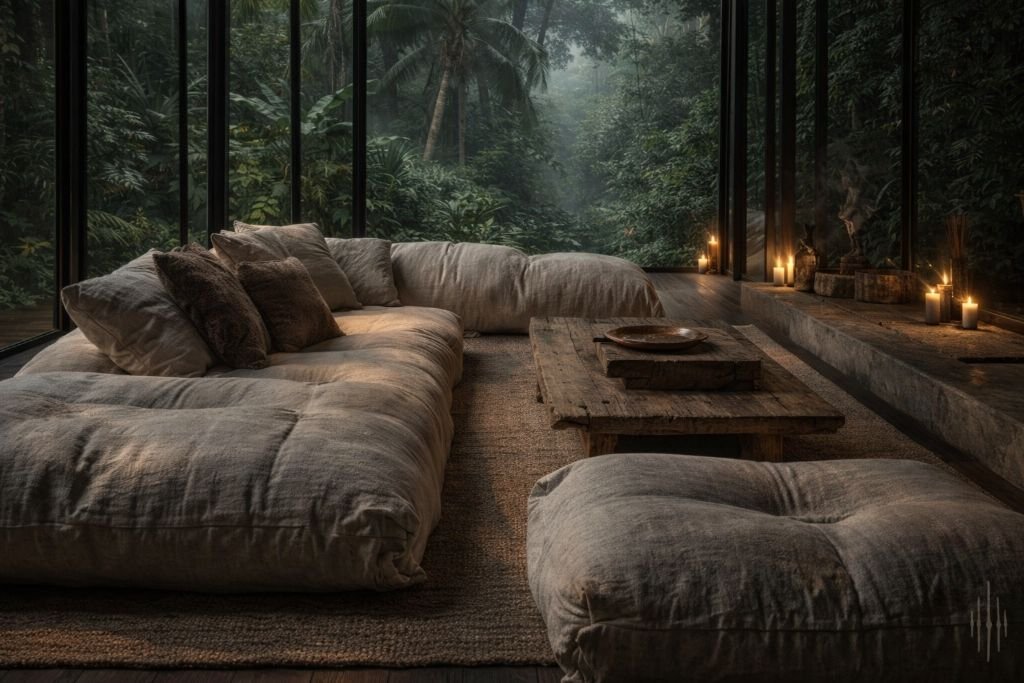 The living room linen cushions, raw timber, jungle glass
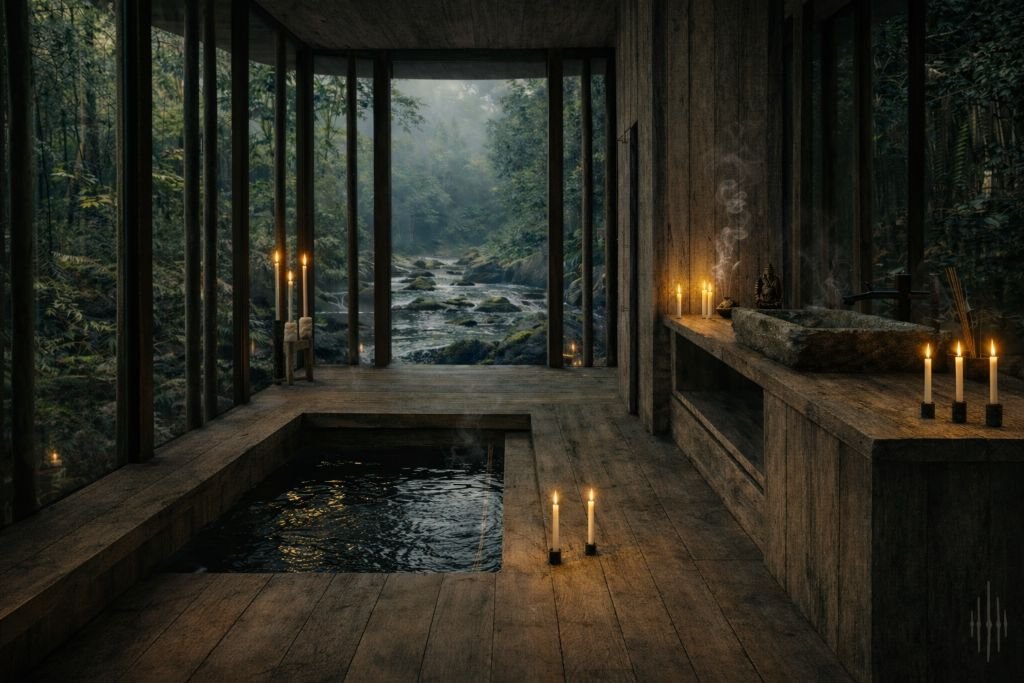 The bathing room sunken pool, river beyond, candlelight
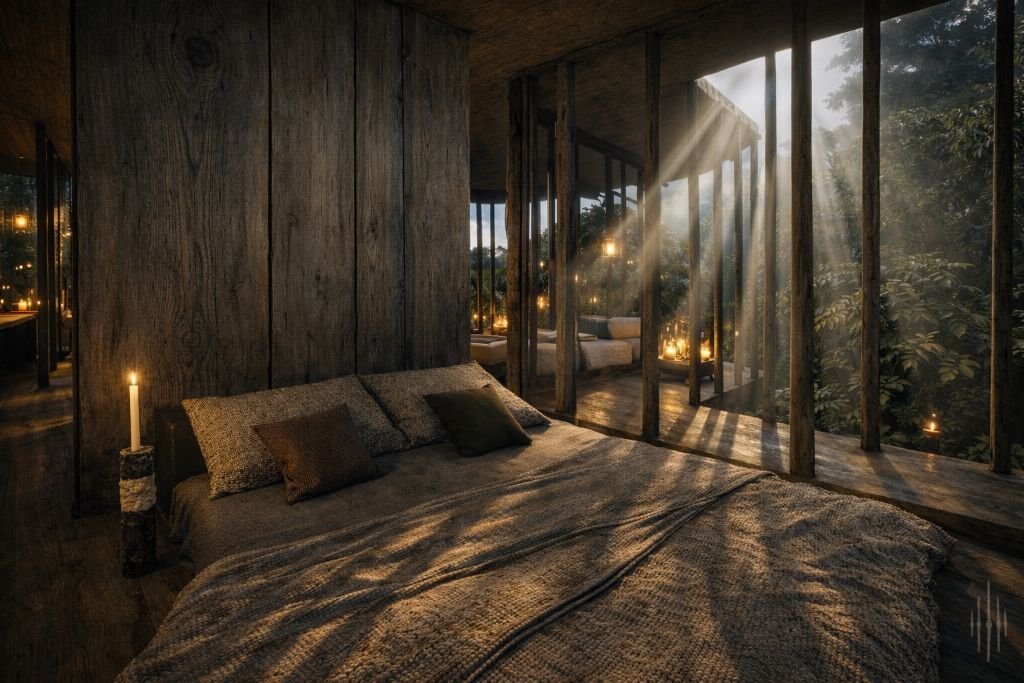 Bedroom morning rays through the canopy
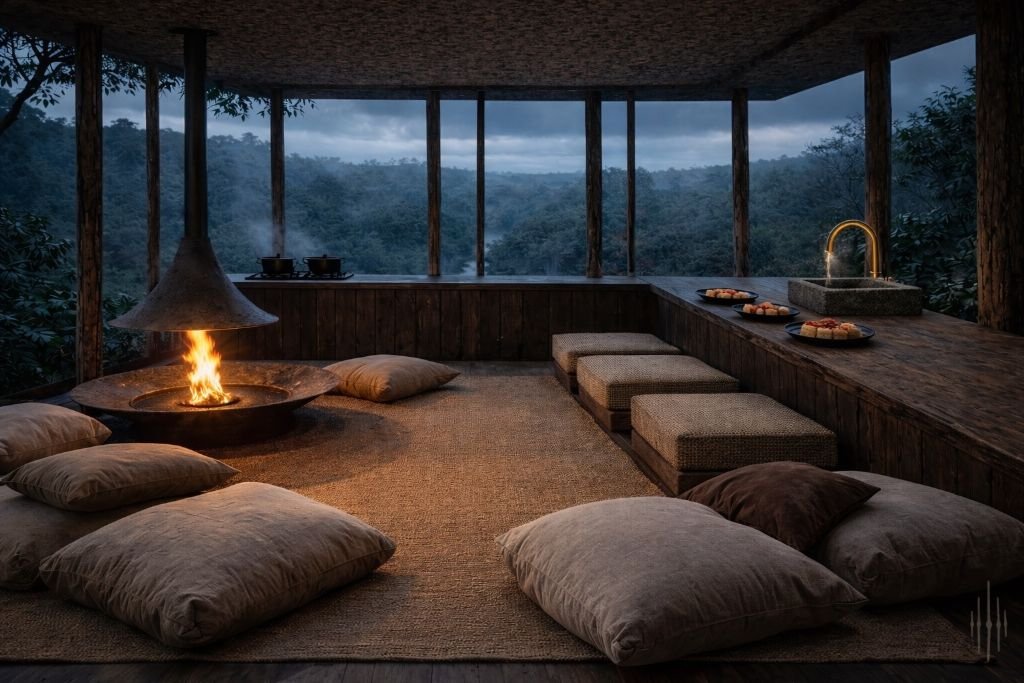 Kitchen terrace fire bowl, storm light, open air
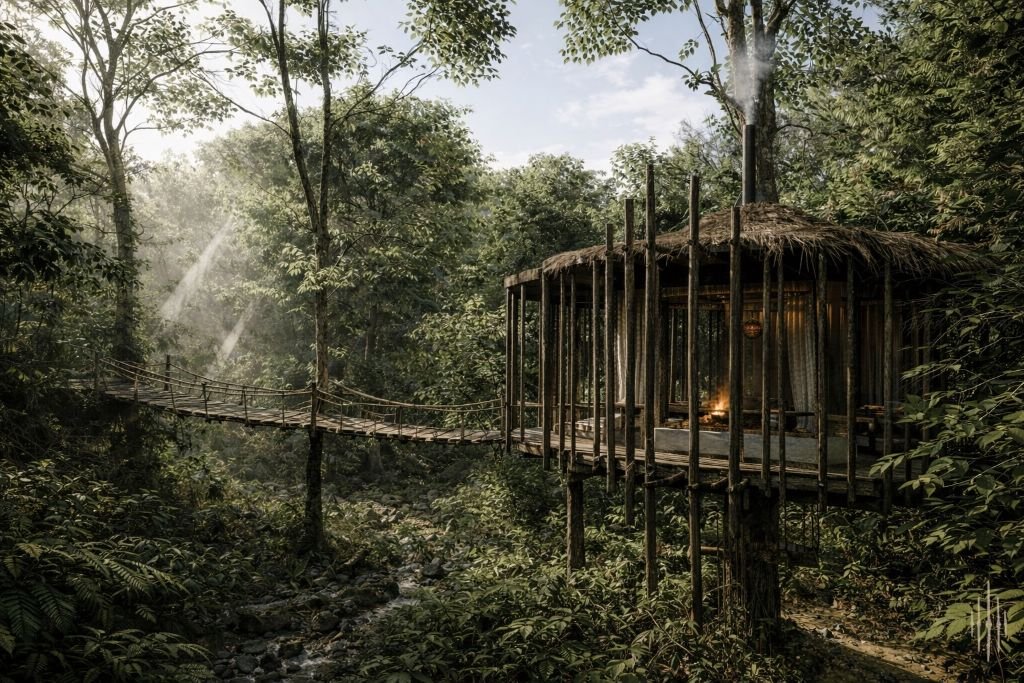 The arrival suspension bridge, forest morning
The Structure
The structural system borrows its logic from the forest itself: a cluster of raw timber columns irregular, upright, alive in material memory holds the volume aloft in the way that trees hold the canopy. No concrete, no steel. Only wood, rope, and the deep knowledge of how things can be bound together without force.
The Material
The thatch roof is both shelter and sound a living layer that hums with rain, breathes with humidity, and ages beautifully over years into deeper shades of amber and grey. Beneath it, raw timber boards and woven panels create walls that admit wind and filter light, making the boundary between inside and outside a question of degree rather than fact.
The plunge bath sunken into the timber floor, oriented toward the stream below is the heart of the bathing room. Its water is cold, clear, and drawn from the same source that has carved the valley floor for thousands of years. To step into it is to touch the jungle's oldest infrastructure.
Spatial Programme
Floor-level linen sofas, a raw timber table, and full-height glass facing the jungle canopy. No barrier between the inhabitation and the forest only glass, and beyond it, everything alive.
A low platform bed wrapped in woven linen, set against raw dark timber planks. Morning light enters through the canopy in angled rays a daily ceremony of slow waking in the forest.
A sunken plunge pool in raw timber, surrounded by candles and opening toward the forest stream. The boundary between bathing and landscape is removed water inside reflects the water below.
An open kitchen terrace with a suspended fire bowl at its centre a gathering place for cooking in the presence of storm light and canopy air. The kitchen as hearth, the forest as dining room.
A slender suspension bridge over the forest stream the threshold between the ordinary world and this private territory. To cross it is to commit to stillness, to the forest, to a different pace of time.
An exterior deck open to the sky for sleeping under stars, for watching the jungle dark, for the particular silence of a forest at 3am when the stars and the fire are the only light for miles.
Design Philosophy
The structure rises into the canopy not to escape the forest floor but to enter a different layer of it where light, air, and sound are entirely transformed by height.
No wall is a barrier here. Glass, timber slats, and open thresholds allow the forest to enter the home continuously in sound, light, temperature, and scent.
Raw timber, woven thatch, and linen remember their origins the forest, the field, the hands that worked them. The materials age and deepen, becoming more themselves with time.
Every act of daily life bathing, cooking, sleeping, waking is given the weight of ceremony by the forest's presence. The ordinary becomes extraordinary when set against the jungle.
Light here is not engineered but invited the slow morning rays through canopy, the candlelight reflected in still water, the firelight against dark timber. The dwelling is shaped as much by light as by structure.
The bedroom forest light as alarm clock